Brookwrite
Columns - 2014
Haggis Sameach
Every year, Jews around the world stare at the charoset on their seder tables and think, "well, at least it isn't haggis."
Haggis is, of course, the infamous interloper of Scottish cuisine that for centuries Jewish mothers have used to encourage their children to keep kosher.
Haggis -- for those who don't know, and especially for those who don't want to -- is essentially a sausage stuffed with various organs, which would actually be more edible if it were instead stuffed with a church organ. Including the pipes.
Nonetheless, to this day, Scots around the world observe Robert Burns Day, by holding a Burns Supper which includes a ritual blessing of the haggis. Robert Burns was the preeminent Scottish poet, and the blessing is a recitation of his poem, "Address to a Haggis."
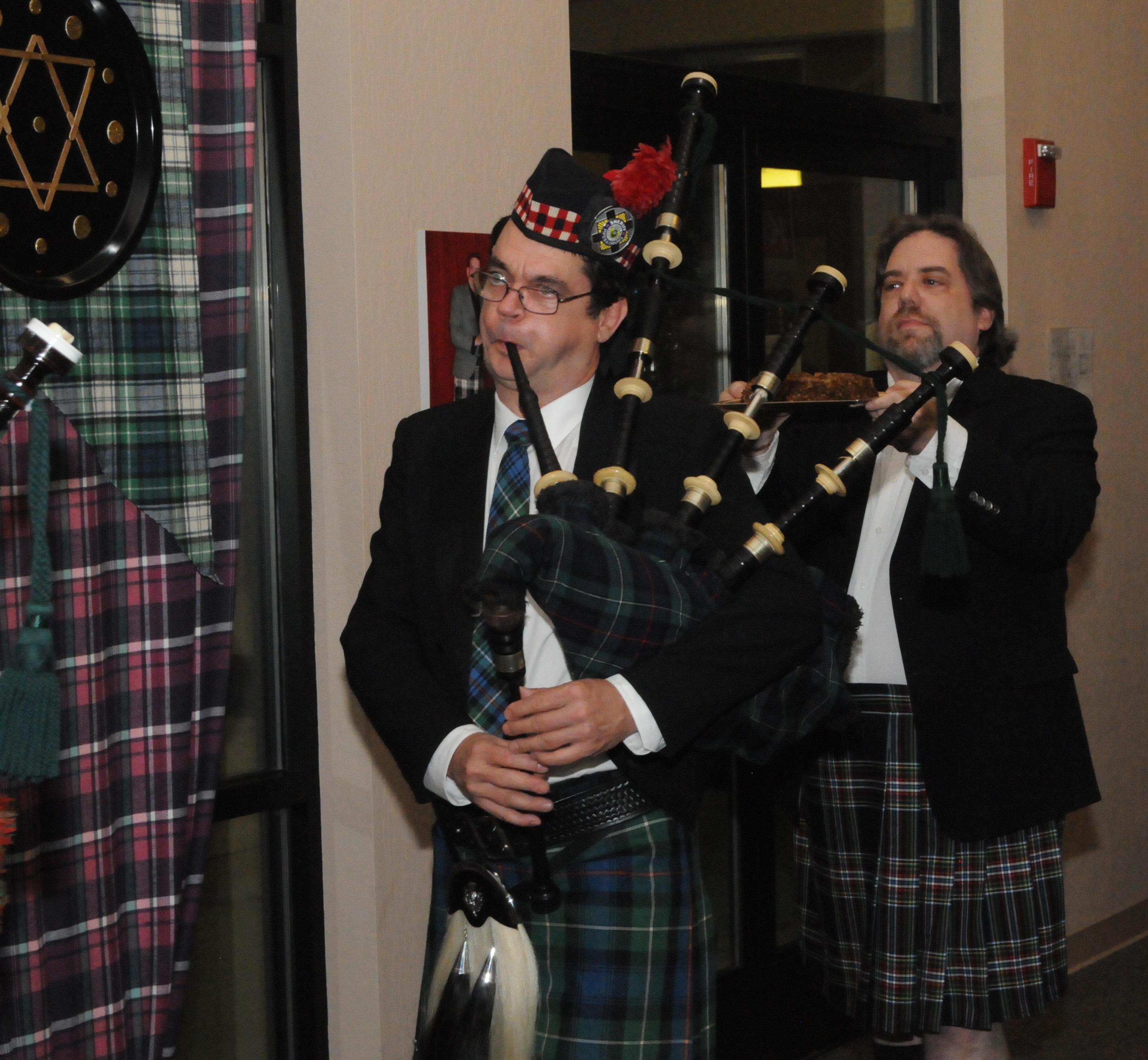
This year, Robert Burns Day coincided with a Saturday night. What's more, it fell on the Saturday night when a particular synagogue held its annual fundraising gala that, accordingly, was done with a Scottish theme. (Yes, Virginia, there are Scottish Jews. At least two of them.)
This synagogue spectacle, which could only be described as a celebration of Robert Burnstein Day (though it wasn't), started off with a traditional blessing of the kosher haggis.
Kosher haggis?!?
Now, while the most popular question is "why?" the more answerable question is "how?" This kosher haggis was vegetarian, though surprisingly -- given the ingredients of truly (and, in the U.S., illegally) authentic haggis -- it did not include heart of palm.
Bear in mind, the interrelation of Jewish and Scottish is not limited to this culinary confluence; it extends to couture.
Scots are known for baring their legs in a kilt. Jews are known for bearing their weight in guilt. But the similarity ends there. Scots wear kilts without guilt, while Jewish mothers give their daughters guilt for wearing anything as short as a kilt. Let alone for not wearing anything under it.
There is also linguistic linkage between the peoples of the single malt and the oy gevalt. Just mention to a Scot that he speaks similarly to Jews and he'll say, "och, yer jokin'," while clearing as much phlegm as you do when you say "chai" and you're not talking about spiced tea.
And just ask anyone in a kilt how it feels to accidentally encounter a bissel thistle. They'll know what you mean.
But before you expect your neighborhood Celt to give you Chanukah gelt, remember the longstanding division between the Jewish and Scottish that dates back to the Days of Yore (B.C.E.).
Through the centuries, nobody has successfully resolved the question of which is more ear-splitting and less fit to put out a coherent tune: bagpipes or shofar.
The only common ground in this time-dishonored conflict is that if you approach either a Jewish or Scottish scholar and ask them the history of it, both will claim that they have no idea what you're talking about. It's that sore a subject.
"Address to a Haggis" was written in Old Scots. Appropriately, for this Burnstein Supper, a regular Torah Reader was asked to do the recitation, because people were already accustomed to enjoying listening to him without understanding a word he's saying.
After completing the blessing of the haggis in the original Old Scots language, there was a recitation of the little-known Talmudic blessing for kosher haggis in the original Old Jews language:
Hamotzi haggis min ha'aretz.
Now you know the appropriate words to say when someone offers you a meal of kosher haggis, unless you had the good sense to say "no" in the first place. But, either way, you can still feel free to toast this vegetarian victual using a double shot of single-malt Manischewitz.
And as we ask ye pow'rs wha mak mankind yer care, and dish us out our bill o' fare... we remind that if ye wish our gratefu' prayer, gie us a haggis... and zie gesundht.
To life! L'haggis!
Doug Brook is a writer in Silicon Valley who, at a synagogue Robert Burns Supper in January, blessed the haggis. You don't want to see a haggis after it sneezes. For past columns, other writings, and more, visit http://brookwrite.com/. For exclusive online content, enjoy facebook.com/the.beholders.eye.