Brookwrite
Columns - 2014
The Cat Mitzvah Speech, Revisited
by Simone
translated by Doug Brook, Southern Jewish Life columnist
originally appeared in January, 2010
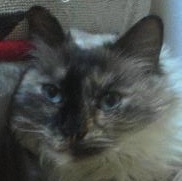
Today I become a Cat Mitzvah. That means many things, not the least of which is that there's kosher pate imported from Paris at the Kiddush after services. While I look forward to Purrim, the holiday celebrating the story of Esther in Purrsia, which is just a few weeks away, I should first talk more about today and its significance to me and therefore to you.
This week's Torah reading, my Cat Mitzvah purrshah, is Bo, from the book of Exodus. It covers the final three plagues before Pharaoh sets the Israelites free to leave Egypt, and the establishment of the holiday of Passover.
Something fundamental here furrows my brow. Why would the Israelites want to leave Egypt? The Egyptians worshipped cats, so they were obviously a highly enlightened people. Yes, the Israelites were slaves, but we didn't tell the Egyptians to do that to them. And the Israelites were stuck in the sandbox for forty years after they left. I'm just saying.
So the Egyptians were visited upon by locusts that darkened the sky, and then darkness that darkened everything for three days. While the Egyptians had to claw their way around during the ninth plague, the only ones who could see were the Israelites, whose dwellings had light according to the Torah, and the cats who could see in the dark.
But why didn't they stop at nine plagues? The Talmud teaches us that by worshipping cats the Egyptians themselves could be considered to have nine lives like the cats they worshipped, which enabled Pharaoh to resist letting the Israelites leave after all nine plagues, and why a tenth plague did him in.
If this reason is true, one can ask why the tenth plague, slaying of the firstborn, was so devastating. After all, if the Big G knew that the tenth plague would work no matter what, the tenth plague could have been spontaneous hay fever or an outbreak of acne and it would have still worked. But there is a Midrash which explains that originally the tenth plague was going to be cat allergies, so we won't complain.
Nevertheless, the tenth plague gives me pause. To prepare for it, the Israelites had to slaughter sheep and mark their doorposts to avoid their own firstborn getting killed. If it weren't for respect for cats as the objects of Egyptian worship, it might have been us.
We're grateful that it wasn't us, and every Passover we remember this and celebrate it, along with celebrating that we usually don't get fed matzah. Or horse radish. Or matzah. We celebrate being spared in this story, which was the origin of the saying, "it takes more than that to skin a cat."
But while cats go largely unmentioned throughout this story, I realize that we don't have to stay invisible in Jewish history. Now that I have become a Cat Mitzvah I am an adult member of the Jewish community. This carries with it the obligation to perform all the commandments just like any other Jew. Putting on tefilin might be tricky, though.
Fortunately, almost all of the commandments, such as dietary rules and use of electricity, I leave in the hands of the person who pays my mortgage. So anything I do against the commandments is probably his fault, and he should be dealt with accordingly. As long as he's home in time to feed me.
However if he makes me adhere to any of the fast days, either intentionally or by accident, he might find that I've invoked some particularly pointed clause against the arm of the sofa. But in becoming a Cat Mitzvah, I know that I cannot do it on Shabbat.
Lastly, I thank my tutor, for believing I was studying while he was at work, and for letting me practice at two thirty every morning for the past two months.
If you want to follow my haftarah, it is on page 395 in Etz Hayim. If you don't want to follow, it's still on page 395.
Simone is a cat in Silicon Valley who graciously lent her house, shedded fur, and occasional typing efforts to this column from 2001 until February 17, 2014. For past columns, other writings, and more, visit http://brookwrite.com/. For exclusive online content, like facebook.com/the.beholders.eye.